
Research and Essays
Beyond the Veil of Time
Eternity, Human Perception, and the Boundaries of What We Know
A Theological and Philosophical Inquiry
The TrinUnity Project
Research & Essays
Purpose
This paper examines what can responsibly be said about divine eternity when biblical theology is placed in conversation with modern physics, human sensory limits, philosophy of time, consciousness research, and the limits of human knowledge. It does not present scientific evidence as proof of God or spiritual reality. Its purpose is to distinguish what is established, what may reasonably be inferred, what theology proposes, and what remains unknown.
Abstract
Christian theology describes God as eternal, yet every human attempt to understand eternity begins from within an existence defined by limitation. Human beings occupy a particular place in space, experience life through finite biological bodies, perceive only portions of the physical environment surrounding them, and ordinarily experience time as a succession of moments moving from past through present toward future. It is therefore reasonable to ask whether human experience provides an adequate conceptual framework for understanding what Scripture means when it describes God as eternal.
Modern science cannot answer the theological question of God's eternity, nor can scientific observations establish the existence of a spiritual realm. Science can, however, demonstrate something relevant to the discussion: human perception and intuition do not provide exhaustive descriptions of physical reality. Human vision detects only a narrow portion of the electromagnetic spectrum, human hearing is similarly restricted, and modern physics has demonstrated that elapsed time does not behave according to the simple universal progression suggested by ordinary experience. Scripture independently describes a spiritual reality that is ordinarily unseen and, in several narratives, becomes perceptible only when God enables perception. These scientific and theological observations belong to different categories of knowledge and must not be confused. Nevertheless, both challenge the assumption that the limits of ordinary human experience necessarily correspond to the limits of reality itself.
This inquiry therefore examines eternity, time, perception, consciousness, spiritual experience, Scripture, and the limits of knowledge. Its central argument is deliberately restrained: established science does not prove theology, but the demonstrated incompleteness of human perception and temporal intuition gives reason for epistemic humility when finite human beings attempt to describe divine eternity.
1. The Problem of Eternity
“Before the mountains were brought forth, or ever thou hadst formed the earth and the world, even from everlasting to everlasting, thou art God.” —
The language of is familiar within Christianity. God is eternal; He precedes creation and is not portrayed as a being who comes into existence within it. Yet familiarity with that confession can conceal the difficulty contained within it. What does it actually mean for something—or Someone—to be eternal?
The human mind naturally approaches eternity by extending its own experience of time. We understand yesterday, today, and tomorrow. We understand decades because we experience years, and we can extend those years intellectually into centuries, millennia, millions of years, and billions of years. Eternity can therefore become an unimaginably long timeline in the human imagination, stretching without beginning or end, with God existing at every point upon it.
That is one possible account of divine eternity, but it is not the only important account in Christian philosophy. A longstanding distinction exists between divine everlastingness and divine timelessness. On an everlasting model, God exists without beginning or end while temporal succession remains meaningful to divine life. On the classical timeless account associated especially with Augustine, Boethius, and Aquinas, God does not merely endure for an unlimited quantity of time; divine life is not divided into the successive moments that characterize creaturely temporal existence. The Stanford Encyclopedia of Philosophy notes both the historical dominance of timelessness and the continuing philosophical debate over timeless and temporal accounts of God.[1]
Scripture establishes God's eternality much more clearly than it explains the mechanics of God's relationship to time. That distinction should be preserved. To say that God is eternal is a theological confession grounded in Scripture. To say that God therefore experiences all moments simultaneously, or exists wholly outside temporal succession, adds a philosophical interpretation. Such interpretations may be coherent and historically important, but they should not be quietly substituted for what the biblical text explicitly states.
The difficulty is intensified because nearly every word humans use to discuss existence is derived from temporal experience. We say that God “was” before creation, “is” now, and “will be” forever, but those grammatical categories already presuppose succession. If God is Creator rather than merely another object within creation, then describing what existed “before” creation may itself involve applying creaturely temporal language to a reality for which such language is only approximate. This does not establish timelessness. It establishes the conceptual problem and invites an examination of the observer asking the question.
2. The Human Observer and the Limits of Perception
Human beings encounter reality through biological systems that provide genuine information while simultaneously imposing boundaries upon what can naturally be perceived. These boundaries are so familiar that they can easily be mistaken for boundaries in reality itself.
Human vision provides one of the clearest examples. NASA describes visible light as the portion of the electromagnetic spectrum detectable by the human eye, typically about 380 to 700 nanometers.[2] Outside that narrow range are infrared and ultraviolet radiation and, farther across the spectrum, radio waves, microwaves, X-rays, and gamma rays. These forms of radiation did not begin to exist when human beings developed instruments capable of detecting them. What changed was not reality but human access to it. This yields a modest but important epistemological principle: the limits of human perception are not the limits of physical reality.
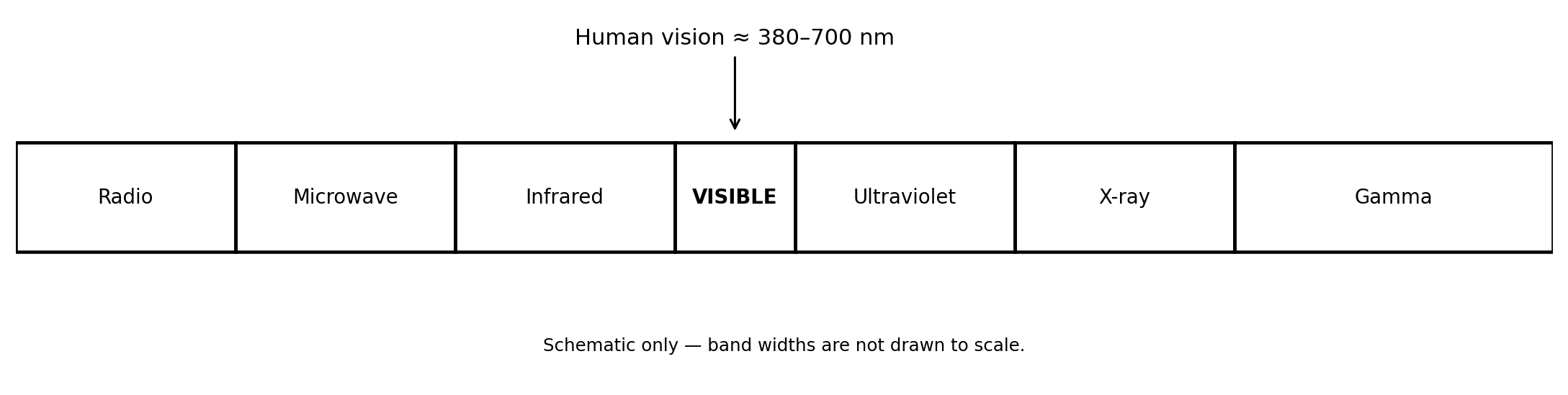
Figure 1. The electromagnetic spectrum and the narrow region naturally visible to the human eye. Schematic; not to scale.
Hearing provides a parallel example. Sound is a mechanical phenomenon requiring a medium, and human auditory perception occupies only part of the possible frequency range. The conventional range for healthy young human hearing is approximately 20 hertz to 20 kilohertz, although sensitivity varies with age and individual physiology. Frequencies below ordinary human hearing are called infrasound; those above it are ultrasound. Other animals detect ranges different from our own. The broader lesson is not that invisible or inaudible physical phenomena are mysterious, but that biological perception is selective.
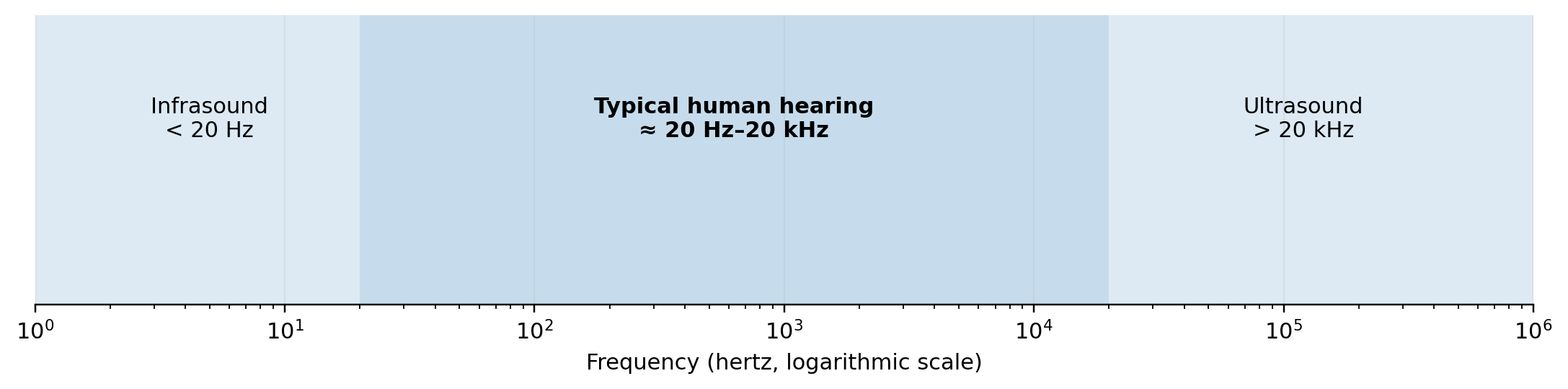
Figure 2. A schematic acoustic-frequency scale showing the conventional human hearing range between infrasound and ultrasound.
This distinction matters when spiritual claims enter the discussion. It would be faulty reasoning to argue that because invisible electromagnetic radiation exists, angels or spirits therefore exist. One proposition does not establish the other. Yet the reverse argument is also faulty: the fact that something cannot be naturally perceived by human senses is not, by itself, sufficient grounds for concluding that it does not exist. Non-perception and nonexistence are not synonymous.
Scripture presents a theological version of this distinction in several narratives. In , Elisha's servant perceives the enemy army surrounding them and reacts in fear. Elisha responds that “,” then prays that the servant's eyes be opened. The servant subsequently sees the mountain filled with horses and chariots of fire. The internal sequence is important: the heavenly forces are not described as coming into existence after the prayer. Elisha already speaks of their presence. The change occurs in the servant's awareness. presents a structurally similar narrative when Balaam initially fails to perceive the angel of the LORD whom the donkey reacts to, until the text says that the LORD opens Balaam's eyes.
These passages provide no scientific mechanism for spiritual perception. They do not identify electromagnetic wavelengths, hidden dimensions, or neurological pathways. Attempting to extract such mechanisms from them would impose modern scientific questions upon texts that do not answer them. What they establish within the biblical worldview is narrower: human beings do not necessarily perceive everything Scripture regards as present. Science and Scripture reach their respective claims through different methods. Science demonstrates limited physical perception; Scripture describes limited spiritual perception. The first does not scientifically prove the second, but both challenge the assumption that immediate human perception exhaustively defines reality.
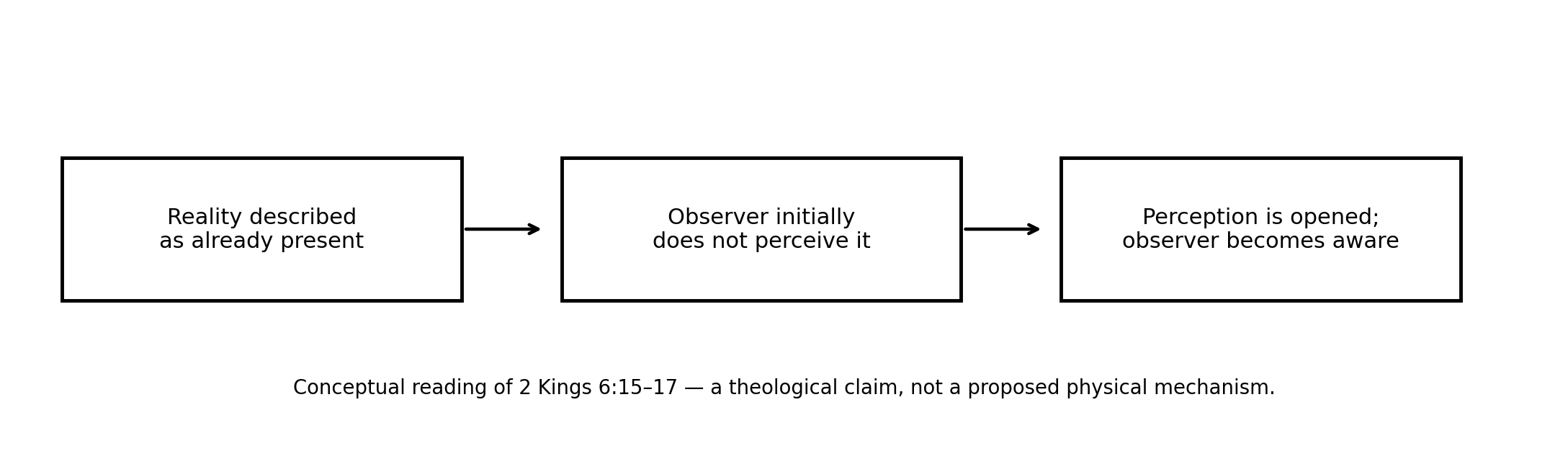
Figure 3. The narrative structure of perception in . This figure represents the theological logic of the text, not a proposed scientific mechanism.
3. Time Beyond Human Intuition
The limitations of perception become even more consequential when applied to time. A common statement in popular philosophical discussion is that “time is a human construct.” Taken literally, that claim is too broad. Hours, calendars, time zones, and systems for numbering years are human conventions, but physical temporal relationships cannot simply be dismissed as inventions. The distinction is analogous to the difference between distance and a ruler: humans invented meters and miles, not spatial separation. Likewise, humans devised clocks and calendars as systems of measurement, but the phenomena being measured are not reducible to those conventions.
Modern metrology makes this distinction unusually concrete. The SI second is defined through the fixed cesium-133 transition frequency, while the meter is defined using the fixed value of the speed of light in vacuum, exactly 299,792,458 meters per second.[3] These definitions are human standards, but they allow extraordinarily precise comparison of physical processes.
Ordinary experience suggests that time passes identically everywhere. Relativity shows that this intuition is incomplete. Special relativity establishes that elapsed time depends upon relative motion, while general relativity establishes that gravity affects clock rates. These effects are experimentally measurable rather than merely philosophical. NIST has demonstrated gravitational time differences with atomic clocks at different elevations, and satellite navigation systems require relativistic corrections to maintain useful accuracy.[4]
The consequence is not that time is unreal. It is that the human experience of time is local and incomplete. Our intuition developed under conditions in which relativistic differences are usually too small to notice. It serves everyday life extraordinarily well while failing to describe every temporal relationship permitted by the physical universe.
Light introduces an even stranger feature. In relativity, light follows a null or lightlike path through spacetime. The proper-time interval along such a path is zero. Popular explanations sometimes say that “no time passes from the photon's perspective,” but that wording is technically misleading because relativity does not define a valid inertial rest frame for a photon. The more defensible statement is simply that the proper time along a lightlike trajectory is zero. This does not prove anything about God. It demonstrates how quickly ordinary language and intuition become inadequate when describing physical circumstances far outside normal human experience.
Relativity therefore must not be turned into a theological shortcut. Einstein's theories do not prove divine timelessness, and no equation in physics establishes God's relationship to eternity. Their relevance is epistemological: human intuition about time is not a complete description of time even within the physical universe. If ordinary intuition is insufficient for understanding created physical time, claims about divine eternity deserve correspondingly greater humility.
4. Infinity, Immortality, and Eternal Life
Current cosmology places the age of the universe at about 13.8 billion years, while Earth is about 4.5 billion years old.[5] These durations are almost impossible to imagine from the standpoint of a human lifetime, but both remain finite. A trillion years is finite. A trillion trillion years is finite. No number becomes infinite merely because it becomes too large for ordinary imagination.
This exposes a conceptual problem with treating eternity as simply “a very long time.” Eternity cannot be reached by adding enough years. In philosophical theology, this is one reason the distinction between everlastingness and timeless eternity matters. An everlasting being may persist without end through temporal succession; a timeless being, if such a mode of existence is coherent, would not possess life as an endless accumulation of successive moments.[1]
The distinction also matters when Christianity speaks of eternal life. If a human being receives eternal life, it does not follow that the person becomes eternal in precisely the same sense in which God is eternal. A created being can logically have a beginning without subsequently having an end. Endless future existence does not require endless past existence.
describes God forming the human from the dust of the ground, breathing the breath of life into him, and the human becoming a living being. The passage does not explicitly describe an eternally preexisting personal soul being inserted into a newly manufactured body. Other biblical passages speak of God knowing persons before birth, forming the human spirit, and the spirit returning to God, but these texts do not by themselves establish conscious personal preexistence. The origin and nature of the soul remain theological questions requiring more than a single proof-text.
The New Testament's emphasis on resurrection further complicates any model in which the body is merely a disposable container. presents Christian hope in terms of resurrection and transformation, not simply the permanent escape of an immortal soul from embodiment. Human immortality may therefore describe a created life that begins and is ultimately sustained without end, whereas divine eternity describes the uncreated life of God. Precisely how that divine life relates to time remains the deeper philosophical question.
5. Consciousness, Extraordinary Experience, and Evidence
The discussion of perception eventually encounters another difficult boundary: consciousness. Neuroscience can identify relationships between conscious states and activity within the nervous system. Vision, memory, dreaming, imagination, anesthesia, and altered states of consciousness all have measurable neural correlates. That establishes the brain's intimate involvement in ordinary embodied consciousness. It does not automatically settle every philosophical question about why consciousness exists or whether every possible conscious event is exhausted by current models of brain function.
This distinction becomes especially important in discussions of near-death experiences and other extraordinary experiences. Recent scientific literature does not present a single uncontested interpretation. A 2025 review in Nature Reviews Neurology develops an integrated neurophysiological and psychological model for near-death experiences, while other recent authors argue that important observations remain insufficiently explained by recorded brain activity and deserve consideration in broader theories of consciousness.[6][7] A 2024 review in Anesthesiology likewise surveys evidence for neurophysiological mechanisms while identifying unresolved questions.[8] The responsible conclusion is therefore not that neuroscience has proved an afterlife, nor that it has closed every question about consciousness near death. The subject remains under active investigation.
A useful logical distinction concerns processing and origin. Demonstrating that the brain processes an experience is not always identical to demonstrating the ultimate origin of every informational component of that experience. Ordinary vision makes the distinction obvious: neural activity is indispensable to the visual experience, but the photons that initiate the process originate outside the brain. Imagination provides the opposite example, where internally generated processes can produce vivid imagery without a corresponding external scene. Proposed spiritual communication would constitute a third category, but unlike ordinary vision and imagination it has not been established as a scientific mechanism. It should therefore remain labeled as theological or experiential interpretation rather than scientific fact.
Personal experience occupies another evidentiary category. A direct experience may reasonably have enormous evidential force for the person who undergoes it while remaining unavailable for independent replication by others. Human knowledge routinely includes testimonial evidence: history, law, biography, and ordinary life all depend upon testimony to varying degrees. Yet testimony requires evaluation, and experience must be distinguished from interpretation. A person may accurately report an extraordinary experience while remaining uncertain about its cause. Fear, memory, prior belief, culture, neurological processes, expectation, and incomplete information can all affect interpretation.
Intellectual honesty therefore requires avoiding two opposite errors. An unexplained experience should not automatically be declared supernatural merely because no immediate natural explanation is available. Conversely, the inability of current instruments to establish a spiritual cause does not logically justify the stronger claim that no spiritual cause could exist. In some cases the evidence supports a conclusion; in others it supports competing possibilities. Sometimes the most accurate answer remains, “I do not know.”
6. Scripture, Interpretation, and the Discipline of Inquiry
The willingness to admit uncertainty becomes especially important when Scripture and scientific evidence appear to conflict. One error is to ask whether a scientific finding agrees with a preferred interpretation of Scripture before seriously considering the evidence. The opposite error is to assume that explaining a physical mechanism eliminates theological meaning. Both approaches risk beginning with the desired conclusion rather than allowing evidence and interpretation to be examined separately.
The age of Earth provides a useful methodological example. Multiple scientific disciplines converge on an ancient Earth of roughly 4.5 billion years.[5] Some Christian chronologies derived from biblical genealogies produce a much younger age. The relevant interpretive question is whether Scripture itself requires those genealogies to function as exhaustive chronological sequences from which the date of creation can be calculated. The presence of genealogies is textual data; the claim that every generation must be chronologically exhaustive is an interpretation of that data. Questioning an interpretation is not necessarily questioning Scripture.
Ancient flood traditions provide a second example. Mesopotamian literature preserves flood narratives that invite comparison with Genesis. The British Museum's Old Babylonian Atrahasis tablet dates to approximately 1635 BCE, while the famous surviving Flood Tablet from the Epic of Gilgamesh is a seventh-century BCE copy of a much older literary tradition.[9][10] The Metropolitan Museum likewise identifies Atrahasis as an ancient Akkadian flood story and notes its comparison with the biblical Noah narrative.[11] These materials establish that flood traditions circulated in ancient Mesopotamia; they do not, by themselves, tell us exactly how the Genesis narrative relates historically to those traditions or what historical event or events lie behind them. Literary dependence, shared cultural memory, remembered catastrophes, theological adaptation, and combinations of these possibilities require historical argument rather than assumption.
The same discipline applies to biblical authority itself. describes Scripture as theopneustos, commonly rendered “God-breathed.” That is a powerful claim about Scripture, but the verse is not itself a table of contents identifying every book later included in the Protestant canon. The preceding verse refers to the sacred writings Timothy had known from childhood, naturally locating the statement within the Jewish scriptural inheritance available to him. The formation and recognition of the New Testament canon involved historical processes within early Christianity. Inspiration, canon, transmission, and interpretation are therefore connected but distinguishable questions.
Recognizing those distinctions need not weaken confidence in Scripture. It can instead prevent Scripture from being made to answer questions that a particular passage does not address. Luke's prologue is itself instructive: the evangelist describes investigating prior accounts and arranging material carefully. Human inquiry and theological conviction are not necessarily opposites.
This methodological principle returns the discussion to eternity. Scripture describes God as eternal, and that confession should be taken seriously. Scripture does not provide a mathematical theory of God's relationship to spacetime, and that limitation should also be taken seriously. The authority of Scripture does not require the interpreter to pretend that Scripture answers questions it leaves open.
7. Beyond the Veil of Time: Synthesis
The different lines of inquiry considered here do not combine into a scientific demonstration of God. Their significance lies elsewhere. Human beings are finite observers whose sensory and conceptual access to reality is genuine but incomplete. Our eyes perceive only part of electromagnetic reality, our ears detect only a limited range of mechanical vibration, our bodies occupy one location and one brief period of cosmic history, and our brains process experience through biological systems whose capabilities are finite.
Even our intuitive experience of time proves incomplete when tested against the physical universe. Relativity demonstrates that elapsed time is affected by motion and gravity. The universe does not conform perfectly to the universal clock imagined by ordinary intuition. Scripture then introduces a theological claim of its own: it describes realities that ordinary human senses do not perceive, records occasions in which individuals become aware of what had previously remained unseen, and describes the Creator as eternal.
These claims cannot simply be merged. Infrared radiation does not prove angels. Time dilation does not prove divine timelessness. Near-death experiences do not scientifically establish heaven. Neural correlates do not, by themselves, disprove every spiritual interpretation of experience. Ancient Near Eastern parallels do not automatically invalidate Scripture, and Scripture does not eliminate the need to investigate creation. The strength of the inquiry emerges precisely when those categories remain distinct.
Science demonstrates that human perception is incomplete with respect to physical reality. Physics demonstrates that ordinary temporal intuition is incomplete with respect to physical time. Scripture claims that human perception is incomplete with respect to spiritual reality. Christian theology claims that the Creator is not merely another creature within the system He creates. None of these propositions scientifically proves the next. Taken together, however, they provide substantial reason for epistemic humility.
Perhaps the greatest obstacle to thinking seriously about eternity is not that humans understand nothing about time, but that we understand enough about ordinary time to assume eternity must simply be more of the same. Years become centuries, centuries become millennia, millennia become billions, and billions become trillions until imagination fails and that failure is labeled eternity. Yet eternity may not be found at the end of that progression.
If the classical Christian account is correct, divine eternity is not an amount of time waiting beyond an unimaginably large number; it is a mode of existence fundamentally different from creaturely temporal succession. If an everlasting model is correct, God may genuinely experience succession while existing without beginning or end. It is also possible that both categories remain imperfect human attempts to describe divine life. The available evidence and texts do not permit this paper to settle the question with certainty.
That is not an embarrassing conclusion. Human knowledge has repeatedly advanced because apparently obvious assumptions proved incomplete. Visible reality expanded when instruments revealed wavelengths beyond the eye. Temporal intuition changed when increasingly precise measurement confirmed relativistic effects. In each case, reality proved larger than unaided experience suggested. There is therefore nothing intellectually irresponsible about approaching eternity with the same humility.
The statement “I do not know” should not function as an escape from investigation. It should mark the point at which evidence ends. There is a profound difference between saying that something is impossible and saying that we do not presently know whether or how it is possible. There is likewise a difference between saying that something has been scientifically established and saying that it remains a reasonable theological or philosophical possibility. Those distinctions protect both science and faith from being asked to claim more than either can establish.
Paul's language in is therefore an appropriate conclusion: “” The significance of the statement is not that knowledge is impossible, but that knowledge is partial. The inquiry remains open at the boundary between what can be demonstrated, what Scripture reveals, what experience suggests, what reason permits, and what remains unknown.
When Scripture describes God as eternal, does it mean that God exists through an infinite succession of time, or does eternity describe an existence that transcends temporal succession itself? When Scripture promises eternal life to created human beings, does it describe the same kind of eternity attributed to God, or the endless continuation of beings who nevertheless had a beginning? If our understanding of physical time has already changed dramatically as our understanding of creation has increased, what further assumptions about reality might eventually require reconsideration?
We do not presently possess answers to every one of those questions. Some may become clearer; others may remain beyond the limits of human investigation. For now, the most responsible position is neither automatic certainty nor automatic dismissal, but continued inquiry. We know something, but we do not know everything, and somewhere between those two statements lies the reason to keep looking beyond the veil of time.
Appendix A — Glossary of Terms
The subjects discussed in this paper draw from theology, philosophy, physics, astronomy, neuroscience, and epistemology. The definitions below explain how specialized terms are used in this work and are intended for the general reader.
Absolute time — The idea that time passes identically everywhere and for everyone, independent of motion, location, or gravity. Modern relativity does not describe physical time this way.
Canon — The collection of writings recognized by a religious community as authoritative Scripture. Questions of inspiration and questions of historical recognition as canonical are related but distinct.
Causation — The relationship between a cause and an effect. Observing what occurs in the brain during an experience does not always answer every question about what ultimately caused that experience.
Consciousness — Subjective awareness: the condition of having experiences such as perceptions, thoughts, memories, emotions, and a sense of self.
Divine eternity — Theological language for God’s existence without beginning or end. Christian philosophers disagree over whether this is best understood as timelessness, everlasting duration, or another relation to time.
Electromagnetic spectrum — The full range of electromagnetic radiation, including radio, microwave, infrared, visible, ultraviolet, X-ray, and gamma radiation.
Empirical evidence — Evidence obtained through observation, measurement, or experiment.
Epistemology — The branch of philosophy concerned with knowledge: what can be known, what counts as evidence, and when belief is justified.
Everlasting — Continuing without end. In this paper it is distinguished from timeless eternity because an everlasting existence may still involve successive moments.
Finite — Having a limit or bound. An extremely large number remains finite.
Frame of reference — A physical system from which positions, motion, and times are measured. Relativity shows that different frames can yield different measurements while remaining physically consistent.
General relativity — Einstein’s theory in which gravitation is described through spacetime geometry. It predicts, among other effects, gravitational differences in clock rates.
Hypothesis — A proposed explanation subject to investigation or evaluation. A hypothesis is not automatically an established fact.
Immortality — Continued life or existence without death or final cessation. Immortality does not logically require existence without a beginning.
Inference — A conclusion reached by reasoning from evidence or premises rather than by direct observation alone.
Infinity — Absence of a finite bound. Infinity is not simply an extremely large finite number.
Interpretation — The meaning or explanation assigned to an observation, experience, or text. Interpretation should be distinguished from the underlying observation itself.
Lightlike / null trajectory — The path followed by light through spacetime. The spacetime interval, and therefore proper-time interval, along an ideal lightlike path is zero.
Metaphysics — The branch of philosophy concerned with the fundamental nature of reality and existence, including questions about time, causation, mind, and what kinds of things exist.
Methodological naturalism — The practical scientific method of investigating natural, observable mechanisms. It should be distinguished from philosophical naturalism, which makes the broader claim that only natural reality exists.
Neural correlate — A measurable neural process associated with a particular conscious state or experience. Correlation identifies association and does not automatically settle every question of ultimate causation.
Perception — The biological and cognitive process through which an organism becomes aware of information. Human perception is filtered and limited by sensory and neural systems.
Proper time — In relativity, the elapsed time registered by a clock along its own path through spacetime. Different paths between events can accumulate different amounts of proper time.
Relativity — Einstein’s special and general theories describing relationships among space, time, motion, and gravity. Relativity rejects the simple Newtonian idea of one universal time shared identically by all observers.
Reproducibility — The capacity for an observation or result to be independently obtained or confirmed under sufficiently similar conditions.
Revelation — In theology, truth understood to be disclosed by God rather than discovered solely through unaided human investigation.
Spacetime — The unified physical framework in relativity in which spatial and temporal coordinates jointly describe events.
Succession / temporal succession — Existence experienced as one moment following another: first one event, then another. Asking whether God experiences temporal succession asks whether divine life unfolds moment by moment as creaturely life does.
Testimonial evidence — Evidence communicated through a person’s report of what they witnessed or experienced. Its value depends upon context, credibility, corroboration, and interpretation.
Theopneustos — The Greek word used in , commonly translated “God-breathed” or “inspired by God.”
Timelessness — The philosophical and theological proposal that God does not experience existence as a sequence of successive moments.
Time dilation — A relativistic effect in which clocks following different motions or experiencing different gravitational conditions accumulate different amounts of elapsed time.
Visible light — The portion of electromagnetic radiation normally detectable by human vision, typically about 380–700 nanometers.
Notes and References
[1] Stanford Encyclopedia of Philosophy, “Eternity in Christian Thought,” especially its discussion of Augustine, Boethius, Aquinas, timelessness, and everlastingness. https://plato.stanford.edu/archives/spr2023/entries/eternity/
[2] NASA Science, “Visible Light,” describing the visible portion of the electromagnetic spectrum and the typical human range of approximately 380–700 nm. https://science.nasa.gov/ems/09_visiblelight/
[3] National Institute of Standards and Technology (NIST), “Definitions of SI Base Units.” The second is defined using the cesium-133 transition frequency; the meter uses the fixed value c = 299,792,458 m/s. https://www.nist.gov/si-redefinition/definitions-si-base-units
[4] NIST, “Putting Einstein to the Test,” and related atomic-clock work demonstrating relativistic clock effects and their practical importance. https://www.nist.gov/atomic-clocks/a-powerful-tool-for-science/putting-einstein-test
[5] NASA materials describing the universe as approximately 13.8 billion years old and Earth as approximately 4.5 billion years old. https://spaceplace.nasa.gov/galaxies-age/en/
[6] Martial, Charlotte, et al. “A neuroscientific model of near-death experiences.” Nature Reviews Neurology 21 (2025): 297–311. doi:10.1038/s41582-025-01072-z.
[7] Angeli-Faez, Bruno, Bruce Greyson, and Pim van Lommel. “Near-death experience during cardiac arrest and consciousness beyond the brain: a narrative review.” International Review of Psychiatry 37 (2025): 130–141. doi:10.1080/09540261.2025.2503729.
[8] Mashour, George A., et al. “Consciousness and the Dying Brain.” Anesthesiology (2024). PMID 38603803; PMCID PMC11096058.
[9] British Museum, Old Babylonian Atrahasis flood tablet, Museum no. 1889,0426.236, dated 1635 BCE. https://www.britishmuseum.org/collection/object/W_1889-0426-236
[10] British Museum, “The Flood Tablet / The Gilgamesh Tablet,” K.3375, seventh century BCE, Tablet XI of the Epic of Gilgamesh. https://www.britishmuseum.org/collection/object/W_K-3375
[11] Metropolitan Museum of Art, “Cuneiform tablet: Atra-hasis, Babylonian flood myth,” describing the Akkadian flood tradition and its comparison with Noah. https://www.metmuseum.org/art/collection/search/321999
Primary Biblical Texts Discussed
; ; ; ; ; ; ; ; . Scripture passage popups use the King James Version (KJV).
Editorial and Scientific Scope Note
This paper is theological and philosophical in purpose and is not presented as a scientific publication. Scientific sources are used to establish relevant features of physical reality and the state of scientific discussion. They are not cited as scientific proof of God, angels, spiritual beings, an afterlife, or any particular theory of divine eternity. Where scientific literature contains competing interpretations, the paper seeks to represent that disagreement rather than resolve it by assertion.